Trademarks
What is a trademark? – A trademark is any word, name, symbol, logo, design, or combination used in commerce to identify and distinguish the goods or services of one party from those of others, and to indicate the source of those goods or services. This definition comes from the United States Patent and Trademark Office (USPTO), which administers the federal trademark registration process in the United States. Federal registration provides nationwide legal presumptions of ownership and exclusive rights to use the mark on the registered goods or services.
Examples of Trademarks:

Why Register a Trademark?
While trademark rights can arise from first use in commerce under common law, federal registration with the USPTO strengthens those rights by:
-
Providing a legal presumption of nationwide ownership and exclusive use;
-
Creating a public record of your claim to the mark;
-
Allowing you to use the ® symbol once registered;
-
Helping to enforce your rights against infringers;
-
Enabling access to federal courts and customs enforcement.
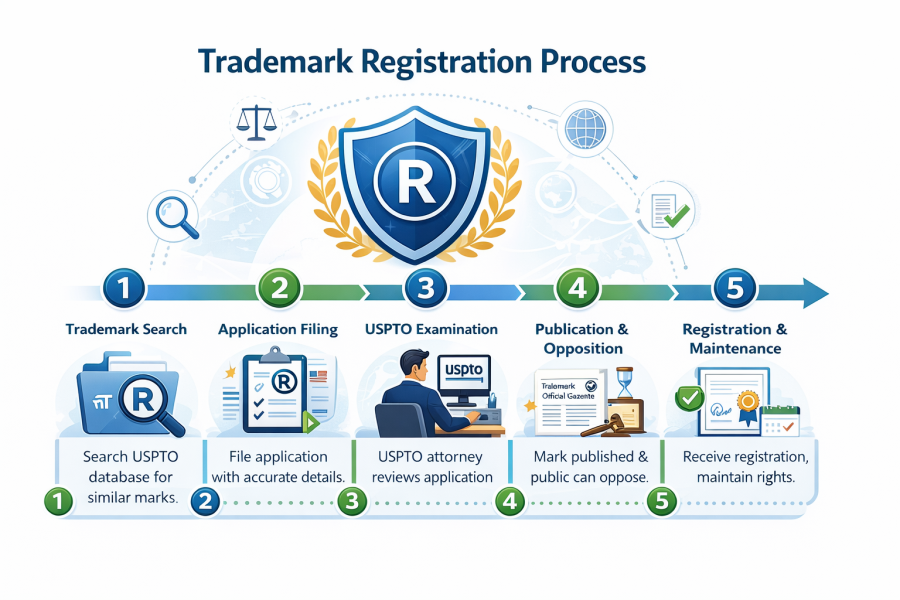
The Trademark Registration Process
Federal trademark registration is a structured process that typically includes:
-
Trademark Search: Searching the USPTO’s Trademark Electronic Search System (TESS) to identify conflicts before filing.
-
Application Filing: Filing a standardized application through the USPTO’s Trademark Center with an accurate description of goods/services and an appropriate filing basis (e.g., use in commerce or intent-to-use).
-
USPTO Examination: A USPTO examining attorney reviews the application, issues Office Actions for legal or procedural issues, and checks for conflicting marks.
-
Publication & Opposition: If approved, the mark is published in the USPTO’s Trademark Official Gazette where third parties have 30 days to oppose the registration.
-
Registration & Maintenance: After overcoming any oppositions and meeting use requirements, the mark moves to registration. Post-registration maintenance filings—such as Section 8 and 9 declarations—are due periodically to keep the registration alive.
Costs and Fees
USPTO filing fees vary by filing form and number of international classes. The most common bases are TEAS Plus and TEAS Standard, with per-class fees charged at the time of filing. Fees change from time to time; the USPTO’s current fee schedule is published on its website.
Trademark Classes and Goods/Services
The USPTO divides goods and services into 45 distinct classes. Accurately identifying the correct class(es) when applying is critical and can affect the scope of your rights.
Who Owns a Trademark?
Ownership generally belongs to the party that first uses the mark in commerce and continues such use, or to the party that first files a bona-fide intent-to-use federal application and later demonstrates use. Federal registration strengthens and clarifies these rights.
Enforcement and Disputes
Registered trademarks can be enforced in federal court for infringement or unfair competition. The USPTO also maintains the Trademark Trial and Appeal Board (TTAB), an administrative tribunal that hears trademark oppositions and cancellation proceedings—but not infringement or damages claims.
How We Can Help
Our attorneys are licensed to practice before the USPTO and assist clients with comprehensive trademark services, including searches, filings, Office Action responses, oppositions, and enforcement strategies across the U.S. and internationally.
Contact Us
Nguyen & Yip, P.C.
20955 Pathfinder Rd.,
Suite 100
Diamond Bar, CA 91765
Phone: (909)
843-6522 Fax: (888)266-4705
Email: Admin@asklawyers.net
Or use our contact form.
New Online Presentation
Check our website to learn more about Nguyen & Yip, P.C. and how we can help you with your legal needs.
 Print
Print 