Overview: What Is a Patent?
A patent is a form of intellectual property protection granted by a government or
regional patent office that gives the patent holder the exclusive right to exclude others from making, using, selling,
offering for sale, or importing an invention for a limited time, in exchange for publicly disclosing the technical details of that invention. In the United States, patents are administered by
the United States Patent and Trademark Office (USPTO). Analogous patent offices exist around the world — such as
the European Patent Office (EPO), Japan Patent Office
(JPO), Korean Intellectual Property Office (KIPO), and China National Intellectual Property Administration (CNIPA) — each with its own procedures and requirements for granting exclusive rights in
their respective territories.
Types of Patents
Your invention must qualify under one of the principal patent categories recognized by the USPTO:
-
Utility Patents – These are the most common type and protect how an invention works or is used, including machines, processes, compositions of
matter, and improvements to existing inventions.
-
Design Patents – These protect the ornamental or aesthetic appearance of a functional item, rather than how it
works.
-
Plant Patents – These cover new and distinct plant varieties that are asexually reproduced.
The choice of patent type affects how the patent is drafted, examined, and enforced. In some cases, an invention may be protected by more than one type (e.g., both utility and
design).
Patent Application Process (U.S. & International)
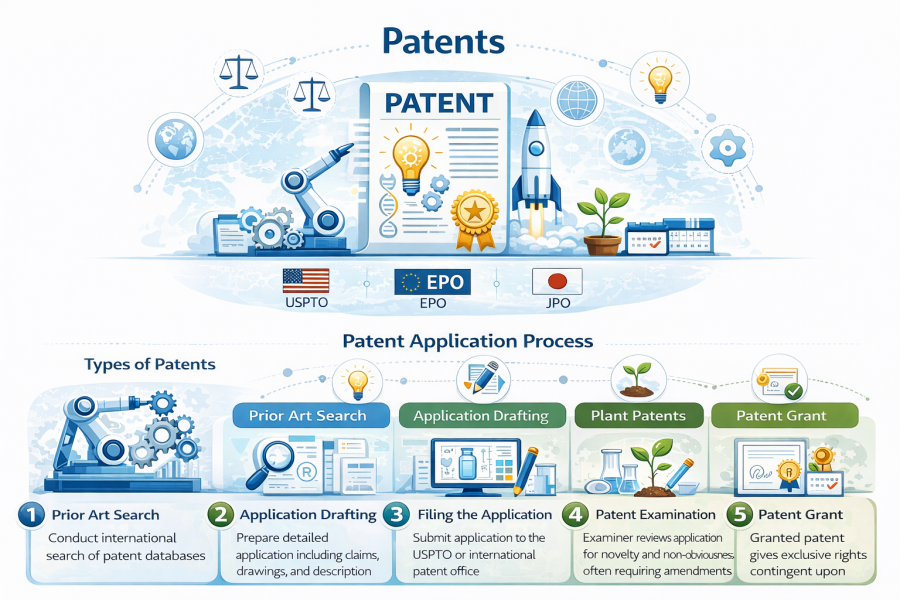
Below is a high-level roadmap that parallels the infographic shown above:
1. Invention Disclosure & Strategy
Before filing, inventors work with counsel or technical advisors to define the invention, assess patentability, and develop an IP
strategy tailored for desired markets.
2. Prior Art Search
A patentability search checks existing patents, applications, and public disclosures to determine whether the invention is novel and non-obvious —
prerequisites for patentability in most jurisdictions.
3. Provisional Application (Optional)
In the U.S., you may file a provisional application to secure an early effective filing date. This gives you up to 12
months to file a full (nonprovisional) application claiming priority.
4. Filing (USPTO or International Offices)
-
U.S. Nonprovisional Patent: Filed through the USPTO’s Patent Center for examination.
-
International Filing (PCT): Through the Patent Cooperation Treaty (PCT) administered
by the World Intellectual Property Organization (WIPO), a single international application can delay and streamline filings in multiple countries by later entering
national/regional phases.
5. Examination & Office Actions
Patent offices review applications for compliance and patentability, issuing Office Actions requiring responses.
Applicants may amend claims and argue patentability until the application is allowed or finally rejected.
6. Patent Issuance, Maintenance & Enforcement
Once allowed, a patent issues and grants time-limited rights (e.g., typically 20 years for a utility patent from the filing date in the U.S.).
Maintenance fees must be paid in many jurisdictions to keep the patent in force.
Patent Costs & Fee Structure
Patent costs generally arise in phases, rather than all at once. Initial expenses typically include prior-art searches and application
drafting, followed by government filing and examination fees. During prosecution, additional costs may be incurred when responding to Office Actions issued by patent examiners. After a patent is granted, maintenance or renewal fees are required to keep the patent in force. For
international protection, costs increase at later stages when entering national or regional phases and complying with local requirements such as translations and
foreign counsel representation.
United States (USPTO)
| Patent Type |
Typical Cost Range |
| Provisional Application |
Lower upfront cost; often used to secure an early filing date |
| Utility Patent |
Higher overall cost due to detailed drafting, claims, and examination |
| Design Patent |
Generally lower than utility patents due to narrower scope |
| Plant Patent |
Varies depending on biological complexity and documentation |
Costs include USPTO filing fees (which vary by entity status) and professional fees for drafting and
prosecution.
https://ipwatchdog.com/2016/08/28/cost-filing-obtaining-maintaining-patents/
International Patents (PCT & National Filings)
| Stage |
Cost Considerations |
| PCT Filing |
Centralized filing with fees payable to WIPO |
| National / Regional Phase |
Separate filing fees for each country or office (e.g., EPO, JPO, CNIPA) |
| Translations |
Required in many jurisdictions |
| Foreign Counsel |
Local representation often mandatory |
| Renewals / Annuities |
Ongoing annual or periodic fees by country |
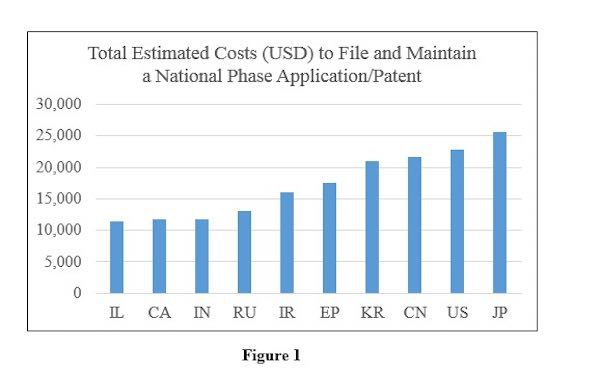
International filings are typically significantly more expensive than U.S.-only protection due to multiple
jurisdictions and long-term maintenance obligations.
How We Can Help
Our experienced patent professionals help inventors, startups, and established companies with all aspects of patent protection — from invention
assessment and strategy, through drafting and filing, to global portfolio management and enforcement in the U.S.
and internationally.
 Print
Print 